
Silicon Carbide (SiC) is currently the most mature third-generation semiconductor material, widely adopted in fields such as new energy vehicles, high-speed trains, aerospace, and wireless communications. To meet the growing demand for high-quality SiC substrates, leading SiC Wafer suppliers like HMT Company provide a comprehensive range of 4H-N and 4H-SI type silicon carbide wafers, available in diameters from 2 inches to 8 inches. Whether for R&D or mass production, HMT’s SiC wafers deliver the exceptional crystal quality and electrical properties needed to power the next generation of high-performance devices.
With its excellent bandgap characteristics, high thermal conductivity, and superior electron mobility, Silicon Carbide is enabling smaller, faster, and more efficient systems—and partners like HMT are helping bring these innovations to market with reliable, scalable wafer solutions.
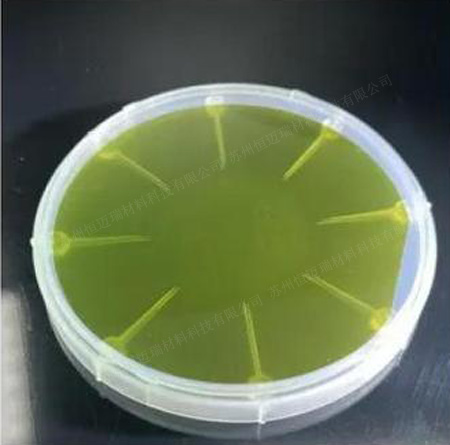 What is Silicon Carbide?
Silicon Carbide (SiC), also known as carborundum, may sound like it has some connection to diamond, and indeed it does. In 1891, American inventor Edward G. Acheson accidentally discovered this carbide during an electric fusion experiment. Mistaking it for a mixture of diamond, he named it "carborundum."
Silicon Carbide is a compound formed by carbon (C) and silicon (Si) elements. Natural SiC ore (moissanite) also exists in nature, but due to its extreme rarity—found only in ancient meteorite craters—most Silicon Carbide on the market is artificially synthesized. Pure SiC crystals are colorless and transparent, while industrially produced Silicon Carbide often appears black or green due to impurities such as iron.

To date, over 200 polymorphic crystal structures of Silicon Carbide have been discovered. Among them, the hexagonal 4H-SiC structure (4H-SiC) offers advantages such as high critical breakdown electric field and high electron mobility, making it an excellent semiconductor material for manufacturing high-voltage, high-temperature, and radiation-resistant power semiconductor devices. It is also currently the most comprehensively performant, commercially mature, and technologically advanced third-generation semiconductor material.
Performance Characteristics Explained:
Bandgap: A larger bandgap results in better high-voltage and high-temperature resistance. The bandgap is inversely proportional to the emission wavelength of light.
Electron Mobility: Higher values indicate greater current-carrying capacity and better high-frequency, high-speed signal processing capabilities.
Saturated Electron Drift Velocity: Semiconductors with high electron saturation drift velocity and low relative permittivity exhibit better frequency characteristics.
Thermal Conductivity: Higher values indicate better heat dissipation capabilities.
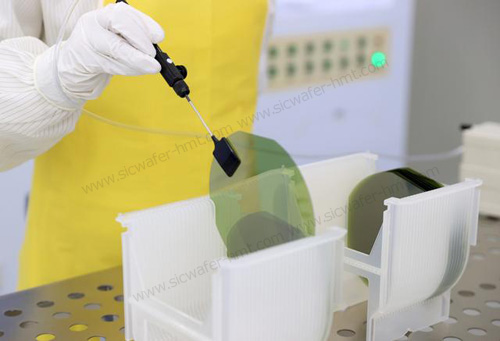
Compared to first-generation semiconductor materials like silicon, Silicon Carbide offers the following advantages:
- Critical breakdown electric field strength is nearly 10 times that of silicon.
- High thermal conductivity, exceeding that of silicon by more than three times.
- High saturated electron drift velocity, twice that of silicon.
- Excellent radiation resistance and chemical stability.
- Similar to silicon, it can directly form a silicon dioxide insulating layer on its surface through thermal oxidation processes.
 Homray Material Technology. All rights Reserved.
 E-mail:kim@homray-material.com;tina@homray-material.com